PracticeStandard
Compliance documents for regulated private practices

The law is changing in BC.

Open and operate your BC psychotherapy or counselling practice with the right documents in place.

By 29 November 2027, psychotherapy and counselling become regulated professions in British Columbia. Practice Standard was built for the practitioners this change affects. The package is a complete set of practice documentation, written by a lawyer: the documents your clients sign, the internal protocols behind them, and the source maps that connect both to the requirements. It is kept current as the new rules are written.

What is changing See what's included
What's Changing

Counselling and psychotherapy are becoming regulated professions in BC

For the first time, practising as a counsellor or psychotherapist in British Columbia will require a licence. The change is enacted, the college exists, and the deadline is set. What remains in motion is the detail — and the time to prepare.

24 Nov 2022Enacted

The Health Professions and Occupations Act is passed, replacing BC's former health-professions framework and bringing counselling and psychotherapy into regulation.

1 Apr 2026In force

The Act comes into force. The College of Health and Care Professionals of BC (CHCPBC) is the regulator that will license the counselling professions.

NowIn progress

Title protection, scope of practice, entry requirements, and practice standards are being developed by the Ministry of Health and the college. This is the preparation window.

29 Nov 2027Deadline

Licensure becomes mandatory. Every practitioner — including an estimated 10,000 currently unregulated counsellors — must be licensed by CHCPBC to practise.

Read the primary sources

This is coming, and the date is fixed. The practitioners who will cross it calmly are the ones whose documentation was in order before the deadline — under the rules already in force, updated as the new standards land. That is what the package is for.
Get compliant before it takes effect

For the fuller picture — what is decided, what is not, and how to prepare — read our CHCPBC 2027 readiness guide.

What's Included

A documented practice system, in three layers

A compliant practice needs more than client forms. It needs the internal protocols a college or privacy regulator expects to see behind them, and the evidence connecting both to the rules. The package delivers all three layers, as editable Word files and PDFs, with the fields to personalize highlighted.

Client documentsWhat your clients read and sign
Informed consent with the limits of confidentiality · consent for clients under 19 (Infants Act) · couples and family counselling addendum · virtual-care consent · counselling services agreement · client privacy notice
Internal protocolsHow your practice runs
Records management policy · privacy breach response plan · third-party records request protocol, with response letters · termination and discharge protocol, with letters · staff and contractor confidentiality agreement · practice closure plan · successor custodian arrangement for incapacity or death
Compliance evidenceProof it maps to the rules
A clause-by-clause source map in every document, with the verification date stated · a one-page implementation note per document — why it exists, which rule requires it, how to put it to use · dated update records as rules change, so your file shows when each document was revised and why
Requirements Covered

The requirements the package covers

Verified against current sources as at 24 August 2026. Where a requirement is still in motion, the entry says so.

The new college Changing

CHCPBC licensure becomes mandatory 29 November 2027; entry requirements and practice standards are still being written.

Health Professions and Occupations Act; CHCPBC transition timeline

Professional practice standards

Consent, competence, documentation, and conduct obligations under the standards in force today.

BCACC Standards of Clinical Practice (2023, rev. 2025); CCPA standards for CCCs

Privacy — PIPA

BC private practices are governed by PIPA: designated privacy contact, written policies, safeguards, access and correction, retention and destruction.

Personal Information Protection Act, S.B.C. 2003, c. 63

Records retention & access

Professional-quality records, secure storage including third parties, defensible retention, and lawful handling of access requests.

BCACC Standard 12; PIPA ss. 23–24, 35

Mandatory reporting & confidentiality limits

The duty to report a child in need of protection, the public-safety exception, and permissive reporting for vulnerable adults — disclosed to clients as consent requires.

CFCSA s. 14; Smith v. Jones, [1999] 1 S.C.R. 455; Adult Guardianship Act s. 46

Minors, couples & families

Mature-minor consent with documented capability assessment, separated-parents authority, and multi-client records with a written secrets policy.

Infants Act s. 17; Family Law Act ss. 40–41

Virtual care

Explicit consent to the specific technology used, suitability assessment, client location and jurisdiction, and an emergency protocol for remote sessions.

BCACC Standard 7 (rev. January 2025)

Emergencies & breaches

A privacy-breach response plan built to the notify-on-risk standard, and emergency planning for clients in crisis.

PIPA s. 34; OIPC BC breach guidance

Continuity: closure, incapacity & succession

What happens to your clients and records if you close, retire, or are suddenly unable to practise — planned in writing, in advance.

BCACC Standard 12.13; PIPA accountability provisions

AI-assisted documentation Emerging

Colleges and privacy regulators are beginning to address AI note-taking and documentation tools. Guidance is developing; the update service tracks it as it lands.

Watched: CHCPBC, OIPC BC, and association guidance

Practice Standard is an independent publisher. It is not affiliated with, or endorsed by, CHCPBC, BCACC, CCPA, or any regulator or association. Documents are mapped to published sources, which are cited inside every document.

How It Works

How it works

Authored

Each document is written by a lawyer, not adapted from a generic template. The author is named, and his credentials are public.

Verified

Every statement of a rule is checked against the current source — the standard, statute, or court decision itself — and the verification date is recorded in the document.

Mapped

Each document closes with a source map connecting its clauses to the rules they implement, so you, an auditor, or a regulator can see the basis for every provision.

Maintained

The system is versioned. When a mapped rule changes, you receive the revised document and a short note describing what changed and what, if anything, to do.

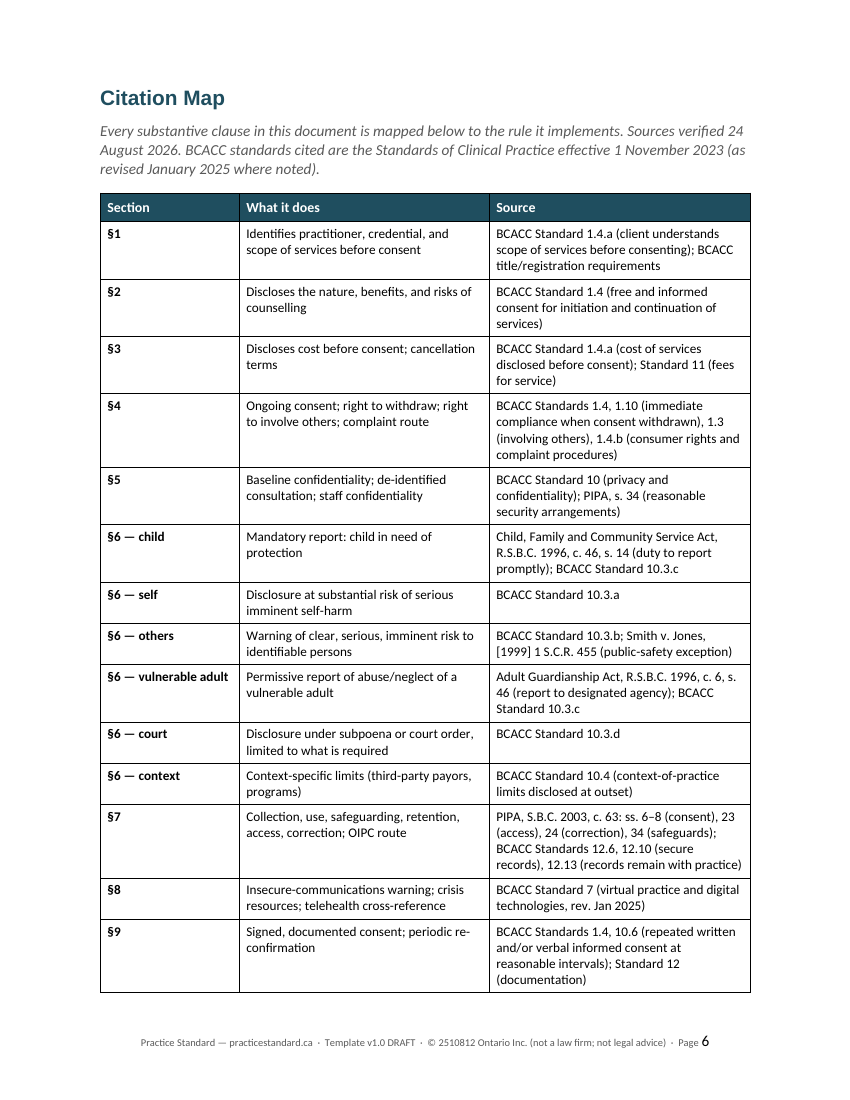
The source map page of the Informed Consent document, tying each clause to its source.
A page from the package. This is the source map from the informed-consent document, the closing section every document carries. Each row ties a clause of the document to the standard, statute, or court decision it implements, with the verification date stated.

Using the package is simple. It arrives by email within one business day of purchase. You replace the highlighted fields with your details, following each document's one-page note. The client documents paste directly into Jane or Owl Practice, with instructions for each platform, or print for signature.

Pricing

Practice Standard for BC Psychotherapists & Counsellors

$399 CAD · one time
  • The complete three-layer system: client documents, internal protocols, compliance evidence
  • Editable Word and PDF, personalization fields highlighted
  • Formatted for direct use in Jane and Owl Practice
  • Twelve months of updates through the CHCPBC transition
  • The CHCPBC 2027 Readiness Guide
Order by email — $399

Online checkout is coming; for now, orders are taken by email and we reply with an invoice and delivery within one business day.

An optional annual update renewal is available after the first year. Sold by 2510812 Ontario Inc. o/a Practice Standard, which is not a law firm; see the Terms of Use & Sale.

Compare your options

This is not the only way to put your documentation in order, and we would rather you compare than take our word.

OptionFinished documentsSpecific to BC counsellingLawyer-authoredSources citedUpdated when rules changeTypical cost
Wait for the college's guidanceNoEventually, and genericallyFree
Association standards and advisoriesRules, not documentsYesSometimesGuidance updatesWith membership
Your practice-management system's formsA few, genericNoNoNoNoIn your subscription
A generic template packYes, genericRarelySometimes "reviewed"NoRarely$50–150
A colleague's forms, adaptedWhatever they hadUnknownUnknownNoNoFree
A lawyer retained by youYes, bespokeYesYesOn requestOnly if re-retained$500–1,000+
Practice StandardThe complete systemYesYesEvery clause12 months included$399 one time

Two notes on this table. Your association's material is authoritative and worth reading whatever you buy. And for advice about your specific circumstances, a lawyer retained by you is the right choice. Practice Standard is neither of those things: it supplies the documentation itself, at a price a private practice can justify.

Updates

Updates through the transition

The requirements governing BC counselling will keep changing between now and November 2027. Every purchase includes twelve months of the update service.

What you receive

When a rule mapped in your documents changes materially, the revised document arrives by email with a short note describing what changed and what, if anything, you must do. Each note is dated.

What we watch

CHCPBC's standards and consultations as they are published; BC PIPA reform, including the anticipated breach-notification requirements; OIPC BC guidance; BCACC and CCPA standard revisions; and emerging guidance on AI-assisted documentation.

After the first year

An optional annual renewal continues the update service. If you let it lapse, your documents remain yours — they simply stop receiving revisions.

About

About Practice Standard

KS

Practice Standard is published by 2510812 Ontario Inc., a company founded by Koby Smutylo, a Canadian business lawyer who is also a practising therapist in Victoria, BC. This package exists because he needed it in his own practice: the legal training is what maps each clause to the rule it implements, and the clinical work is what keeps the documents grounded in the situations a real practice meets, in language clients can read.

Practice Standard is a separate company from both his law practice (lawyercorporation.ca) and his therapy practice (victoriarelationshiptherapy.ca). It is not a law firm, and purchasing its documents does not make you a client of any of the three.

Questions

Common questions

Is this legal advice?

No. Practice Standard sells document templates authored by a lawyer, but it is not a law firm, does not provide legal services or legal advice, and no lawyer-client relationship is formed by purchasing or using the documents. If you need advice about your specific situation, consult a lawyer you retain.

I'm an unregulated counsellor planning to register with CHCPBC. Is this for me?

Yes. The package was designed for practitioners entering regulation for the first time. College oversight means operating with documented consent, privacy, records, and continuity practices, and the package establishes those now, under the standards already in force. The update service then carries your documents through as the college's own standards are published.

The college's standards aren't final. Why buy now?

Because most of your obligations are already in force and are not waiting for the college: PIPA, the duty to report a child in need of protection, the Infants Act consent framework, and the professional standards of BCACC and CCPA. Documents described as "CHCPBC-compliant" cannot exist yet, because the college's standards are not written. This package maps to the current sources and is updated as the college's standards are published.

I already have forms in Jane or Owl Practice. Do I need this?

Your practice-management system is the delivery mechanism: signatures, storage, workflow. Its generic text leaves content responsibility with you, under those platforms' own terms. Most of this package — the records policies, breach response plan, third-party request protocol, succession and closure planning — has no equivalent in any practice-management system, and the client documents paste directly into Jane and Owl, with instructions.

Can I edit the documents?

Yes. Every document is delivered as an editable Word file as well as a PDF, with the fields to personalize highlighted, and each comes with a one-page note explaining its purpose and use.

How is this different from an inexpensive template pack?

Open any document and read its source map: every substantive clause is tied to the standard, statute, or court decision it implements, verified as at a stated date. If a template cannot show its sources, its claims cannot be checked. These can be.
Practice Standard is launching first for psychotherapists and counsellors in British Columbia. Additional professions and provinces are planned.

Practice Standard is not a law firm and does not provide legal services or legal advice. The documents sold on this site are templates for general use by regulated professionals, and the requirements overview is general information only; neither is advice about your circumstances, and no lawyer-client relationship is created with anyone, including their author. Content is current as of its stated version or verification date. For advice about your specific circumstances, consult a lawyer retained by you.